
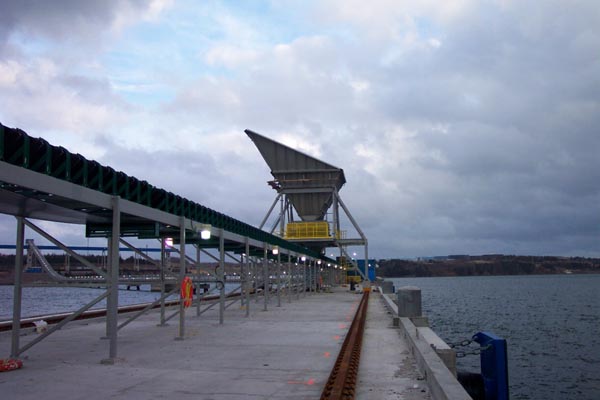
Ports and marine terminals are critical connections in the movement of bulk materials. Whether cargo is arriving by vessel, rail or truck, terminal infrastructure needs to move material efficiently between unloading, conveying, storage and loading operations.
BID Canada designs and manufactures custom bulk material handling equipment for ports, marine terminals and other industrial facilities. From individual conveyors and transfer points to multiple components within an integrated handling system, our equipment is engineered around the material, capacity, operating environment and requirements of each site.
Based in Woodstock, New Brunswick, BID provides engineering, fabrication and material handling expertise for projects throughout Eastern North America.
Dry bulk terminals can handle a wide range of materials, each presenting different challenges for equipment design.
Minerals and ores may require equipment capable of handling dense and abrasive material. Salt and other corrosive materials require careful consideration of the surrounding environment, materials and protective coatings. Cement, aggregates and other dry bulk products introduce their own requirements for material flow, transfer and containment.
BID works with owners, engineering consultants and project partners to develop material handling equipment around these operating conditions.
Our port and marine terminal capabilities include:
Conveyors connect the different stages of a bulk terminal, moving material between receiving areas, storage facilities, processing equipment and loading points.
BID designs and manufactures custom conveyor systems based on the properties of the material being handled and the requirements of the facility. Capacity, bulk density, particle size, moisture, abrasiveness, conveyor length, elevation changes and loading conditions can all influence system design.
Our team can provide individual conveyors for an existing terminal or work as part of a larger project to develop multiple pieces of an integrated bulk material handling system.
Equipment operating at a port faces conditions that extend beyond the material being conveyed.
Moisture, salt exposure, temperature changes and other environmental factors can influence equipment selection and long-term performance. These conditions need to be considered alongside the characteristics of the bulk material itself.
BID’s engineering and fabrication teams consider the operating environment when developing conveyor structures, transfer points, guarding and other components. Depending on the application, this can include consideration of material selection, protective coatings, component specifications, access and maintenance requirements.
The objective is not simply to move material from one point to another, but to develop equipment suited to the conditions in which it will operate.
Every transfer creates an important transition within a bulk handling system.
BID designs and fabricates custom chutes and transfer components to help direct material between conveyors, hoppers, storage areas and other equipment.
Chute geometry, material characteristics, flow rate, wear and surrounding equipment are considered as part of the design. Wear-resistant materials and liners can also be incorporated where required for abrasive applications.
Bins and hoppers provide controlled storage and discharge within port and terminal material handling systems.
BID fabricates custom bins and hoppers based on required volume, material characteristics, available space and downstream equipment. Designs can incorporate structural reinforcement, wear-resistant materials, custom outlets, access points and connections to surrounding conveyors and chutes.
For terminals connecting marine transportation with road networks, efficient receiving and unloading equipment can be an important part of overall material flow.
BID designs and manufactures heavy-duty truck dumpers and can integrate unloading equipment with hoppers, conveyors and downstream bulk handling systems.
Systems are developed around the requirements of the facility and the materials being received.
BID’s experience in port material handling includes a recent project for a Quebec port client involving three custom belt conveyors.
Two conveyors were designed to handle iron ore, a dense and abrasive material requiring components capable of operating under significant loads and wear. A third conveyor was designed specifically for salt, where both the characteristics of the material and exposure to the marine environment required additional consideration of corrosion and long-term equipment durability.
The project demonstrates an important part of BID’s approach to bulk material handling: equipment should be engineered around what it is moving and where it is operating.
Ports and marine terminals are often more than points of arrival and departure. They connect marine shipping with road, rail, storage and industrial operations.
Material handling equipment forms the physical connection between these modes of transportation.
Well-planned conveyors, receiving equipment, transfer points and storage systems can help create a more efficient path for bulk cargo through the terminal while accommodating the realities of the existing site.
For new installations, expansions and modernization projects, BID can work with the project team to develop equipment that integrates into the broader terminal infrastructure.
BID combines engineering and fabrication at our facility in Woodstock, New Brunswick.
Keeping these capabilities closely connected allows our engineers and manufacturing team to work together throughout a project, from initial equipment concepts and detailed design through fabrication and preparation for installation.
Our modular construction capabilities can also allow equipment and structural components to be preassembled before shipment where practical, helping reduce the amount of work required at the project site.
For port projects where access, scheduling and installation windows can be significant considerations, designing equipment with transportation and installation in mind can be an important part of the overall project.
Canada’s ports connect domestic industries with markets throughout North America and around the world. Bulk terminals play an important role in moving commodities including minerals, forest products, agricultural products, salt, cement and other industrial materials.
Continued investment in port and transportation infrastructure is increasing the need for efficient connections between vessels, storage facilities, road and rail transportation.
Reliable bulk material handling equipment is an important part of that infrastructure.
Whether you are planning a new bulk terminal, expanding an existing facility or replacing aging material handling equipment, BID can work with your team to develop equipment around your site’s requirements.
Tell us what you need to move, how much you need to move and where it needs to go.


